
About Us
In the year 2004 our hospital and the medical services became more professionalized, with a reorganization of hospital management along more bureaucratic and administrative lines. The Apothecaries Act 1815 made it compulsory for medical 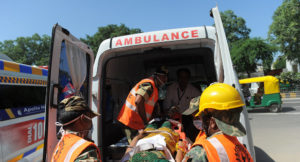 students to practice for at least half a year at a hospital as part of their training. An example of thisprofessionalization was the Charing Cross Hospital, set up in 1818 as the 'West London Infirmary and Dispensary' from funds provided by Dr. Benjamin Golding. By 1821 it was treating nearly 10,000 patients a year, and it was relocated to larger quarters near Charing Cross in the heart of London. Its Charing Cross Hospital Medical School opened in 1822. It expanded several times and 1866 added a professional nursing staff. Resuscitation room bed after a trauma intervention, showing the highly technical equipment of modern hospitals Florence Nightingale pioneered the modern profession of nursing during the Crimean War when she set an example of compassion, commitment to patient care and diligent and thoughtful hospital administration. The first official nurses’ training programme, the Nightingale School for Nurses, was opened in 1860, with the mission of training nurses to work in hospitals, to work with the poor and to teach.
Nightingale was instrumental in reforming the nature of the hospital, by improving sanitation standards and changing the image of the hospital from a place the sick would go to die, to an institution devoted to recuperation and healing. It also emphasized the importance of statistical measurement for determining the success rate of a given intervention and pushed for administrative reform at hospitals.During the middle of the 19th century, the Second Viennese Medical School emerged with the contributions of physicians such as Carl Freiherr von Rokitansky, Josef Škoda, Ferdinand Ritter von Hebra, and Ignaz Philipp Semmelweis. Basic medical science expanded and specialization advanced. Furthermore, the first dermatology, eye, as well as ear, nose, and throat clinics in the world were founded in Vienna.
Our Brief History
Suprahos Multi-speciality Hospital was in the stage of reforming the nature of the hospital, by improving sanitation standards and changing the image of the hospital from a place the sick would go to die, to an institution devoted to recuperation and healing.It also emphasized the importance of statistical measurement for determining the success rate of a given intervention and pushed for administrative reform at hospitals.During the middle of the 19th century, the Second Viennese Medical School emerged with the contributions of physicians such as Carl Freiherr von Rokitansky, Josef Škoda, Ferdinand Ritter von Hebra, and Ignaz Philipp Semmelweis. Basic medical science expanded and specialization advanced. Furthermore, the first dermatology, eye, as well as ear, nose, and throat clinics in the world were founded in Vienna.
 |
 |
 |
|
Founders
The Apothecaries Act 1815 made it compulsory formedical students to practice for at least half a year at a hospital as part of their training. An example of thisprofessionalization was the Charing Cross Hospital, set up in 1818 as the 'West London Infirmary and Dispensary' from funds provided by Dr. Benjamin Golding. By 1821 it was treating nearly 10,000 patients a year, and it was relocated to larger quarters near Charing Cross in the heart of London. Its Charing Cross Hospital Medical School opened in 1822. It expanded several times and 1866 added a professional nursing staff